How to Integrate LLMs and AI Agents into Enterprise SaaS: A Practical Architectural Blueprint

Abdullah Mubin
Founder
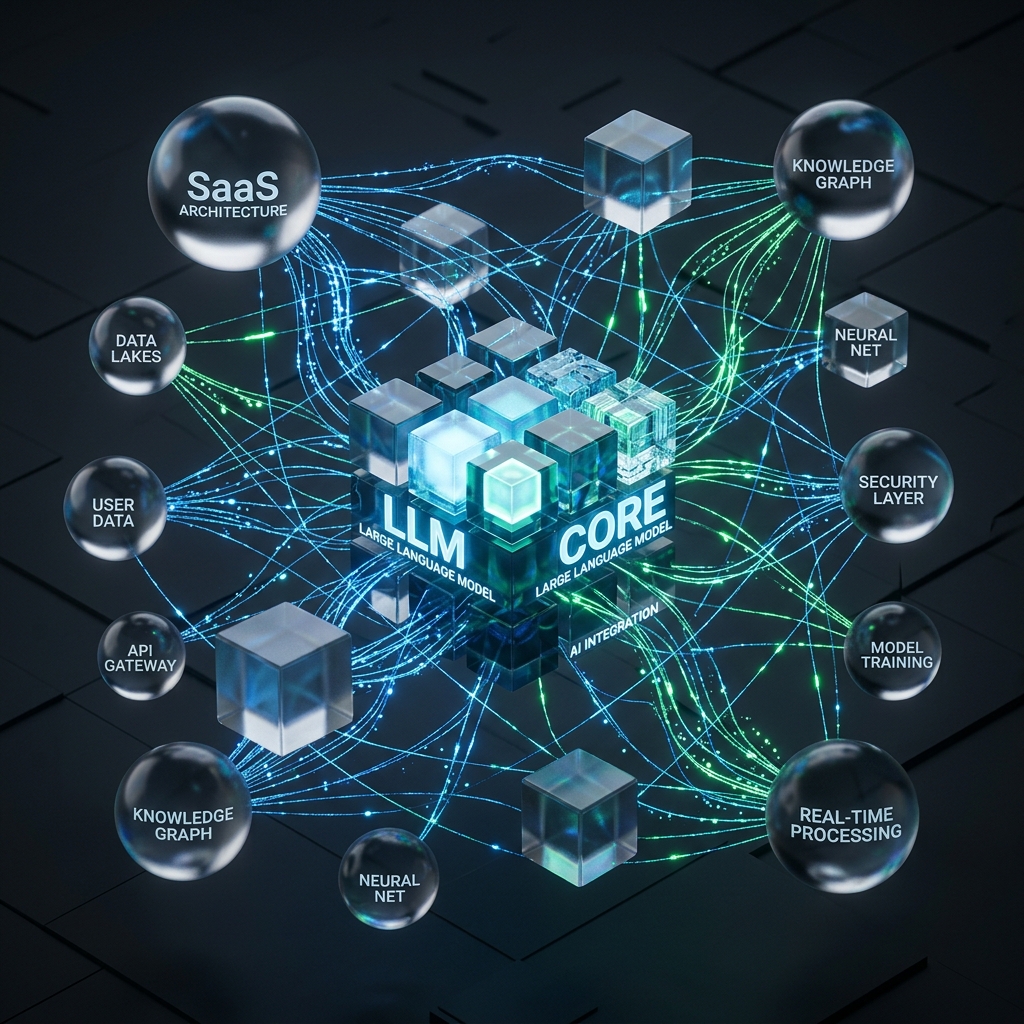
Artificial Intelligence is no longer just a chatbot floating in the corner of a website. For modern enterprise SaaS platforms, AI has become the core infrastructure. Users expect systems to automatically analyze data, generate summaries, and perform complex workflows using autonomous AI agents.
But taking a prototype from a local Jupyter notebook and deploying it into a production SaaS environment is a massive engineering challenge. You must address API rate-limiting, latency issues, prompt security, and vector database scaling. In this guide, I will share the enterprise-grade AI architecture blueprint we use at Wizora Studio to build scalable, production-ready AI features.
The Production AI Architecture Stack
A production-ready AI architecture requires a dedicated data pipeline. The three core layers of this stack are:
- LLM Orchestration Layer: Using frameworks like LangChain or Vercel AI SDK to manage context windows, system prompts, and model routing.
- Vector Database Layer: Utilizing high-performance vector databases (such as Pinecone, Qdrant, or pgvector in PostgreSQL) to store and query high-dimensional embeddings.
- Semantic Caching Layer: Implementing Redis or custom semantic caches to store prior LLM responses, cutting latency and API costs in half.
Retrieval-Augmented Generation (RAG) Flow
Enterprise data is proprietary and changes constantly. Fine-tuning a model is expensive and gets outdated quickly. Instead, we use Retrieval-Augmented Generation (RAG) to retrieve relevant context from a database and inject it into the prompt at runtime.
Here is the architectural sequence of a secure RAG request:
- Vector Indexing: When a document is uploaded, it is broken into smaller semantic chunks (e.g., 500-1000 tokens) and converted into high-dimensional vector embeddings using an embedding model (like OpenAI's
text-embedding-3-small). These vectors are stored in the vector database. - Semantic Search: When a user asks a question, the query is converted into an embedding. The vector database performs a cosine similarity search to retrieve the top 3-5 most relevant document chunks.
- Prompt Assembly: The retrieved document text is combined with the system instructions and user query into a structured context window.
- LLM Generation: The assembled prompt is sent to the LLM (like GPT-4o or Claude 3.5 Sonnet) to generate a grounded, accurate response.
"RAG is the only way to ensure your LLM has access to real-time, private enterprise data without the risk of hallucination or exposing training sets to the public model."
Building a Semantic Cache with Redis
LLM API calls are slow and expensive. If two users ask similar questions, there is no reason to pay for two separate model generations. A standard key-value cache doesn't work because natural queries differ slightly in wording.
We solve this by building a semantic cache. When a query comes in, we convert it to a vector and run a similarity check on previously cached queries in Redis. If a match is found with >0.95 similarity, we return the cached response instantly, reducing response times from 3 seconds to under 50ms.
// Pseudocode for Semantic Cache Routing
async function handleQuery(userQuery: string) {
  const queryVector = await generateEmbedding(userQuery);
  const cachedResult = await redis.vectorSearch('cache_index', queryVector, 0.95);

  if (cachedResult) {
    return cachedResult.answer; // Returned instantly
  }

  const llmResponse = await callLLM(userQuery);
  await redis.saveCache(queryVector, userQuery, llmResponse);
  return llmResponse;
}
Handling Rate Limits and Agentic Workflows
AI agents are autonomous loops that run multiple LLM queries in sequence to solve a task. This can quickly hit API rate limits and create loops that generate huge bills.
To build safe agentic workflows:
- Token Buckets: Implement token bucket rate limiters in your backend middleware (using Redis token bucket algorithms) to prevent any single organization from exhausting your API limits.
- Max Iteration Limits: Always hardcode a strict limit (e.g., maximum 5 loops) on recursive agent thoughts. If the agent does not solve the task in 5 steps, it must stop and request human feedback.
- Asynchronous Processing: Run long-running agent tasks in background queues (using tools like BullMQ or Celery) rather than blocking the main client request. Send updates to the client via WebSockets or Server-Sent Events (SSE).
Conclusion
Integrating AI into enterprise software is an exercise in resource management, caching, and rate limiting. By implementing a robust RAG pipeline, semantic caching, and strict agent guardrails, you can build powerful AI features that are fast, secure, and cost-efficient. If you need assistance designing your platform’s AI infrastructure, reach out to our team at Wizora Studio.